
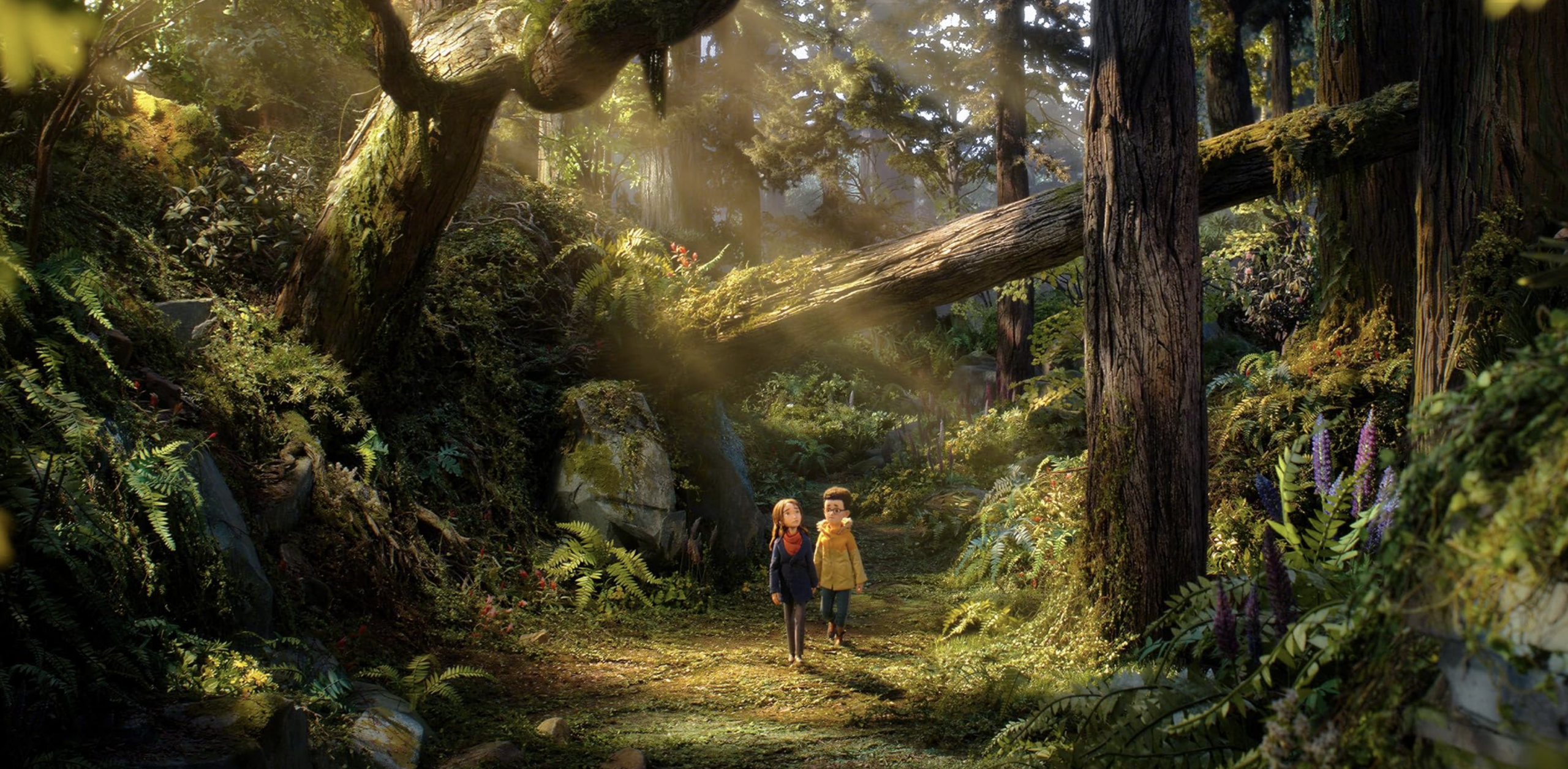
The following questions and answers are excerpted from a conversation that followed the NBR screening of Wildwood.
The film feels like a magic trick in some ways, because it’s so rare to see a film of this delicate craftsmanship on such a huge scale with this kind of length. How did you set out to make a project of this scale?
Travis Knight: It’s funny you say that, because I do feel like it is a magic trick. I’m sure pretty much everyone here in the room knows, but at the dawn of cinema, a lot of the early innovations came from stage magicians who were looking to find new ways to bring their illusions to life, including stop motion. For those of you who don’t know stop motion, we always put a little bit of something at the end of the movie where we show how the magic trick was done. We peel back the curtain and explain the process. You make thousands of these tiny little things, move them a bit at a time, take a picture, move them again, take a picture, and so on. You do it over and over again.
When Colin Meloy— who’s also the frontman and main songwriter for The Decemberists—wrote the book this film is based on, that was 16 years ago. This is something that’s been a part of LAIKA for almost our entire existence. We only finished it a handful of weeks ago, really. We went down to the wire because we just wanted to make sure that everything was as good as we could get it. It is a little insane because these things are shot essentially on tabletops with miniatures, and we wanted them to feel like a big live-action spectacle. That’s kind of crazy. You have to pull off a lot of different tricks to make that happen, and we had to innovate all along the way.
With each successive film, we built on our technological bag of tricks
There was a period of time when you weren’t ready to make it, when the technology wasn’t there. What had to happen for you to feel like it was time for Wildwood?
TK: It was a lot of different things. At the time, we’d just done Coraline, which came out in 2009. It was 2010 when I discovered the manuscript. Coraline really did represent a seismic shift in what was possible in stop motion. We did so many different technological innovations, and that was one of the things we embraced very early in the life cycle of the company when we started it. It was very clear, going back a little over 20 years ago, that stop motion was dying. CG was in the ascendancy; it was taking over. Computers could do everything we could do faster, cheaper, and with more precision than our big, giant ham hands. We had to reconcile with that. Was there a place for us? Was there a future for us in this handmade medium to tell stories?
What we did was essentially embrace the author of our demise, the infernal machine, and brought that into our process because, the way we thought of it, it’s just a tool. A computer is just another tool, like a pencil, a paintbrush, or a 3D printer. We integrated technology into what is historically an art and a craft, and that allowed us to come up with some innovations that we used on Coraline. In the meantime, when I read the novel, I recognized that even though I desperately wanted to tell this story, I had no idea how we could tell it. It was too big, too ambitious, too sweeping, with too many locations and too much spectacle. There was absolutely no way we could do justice to this story. So it was left on simmer for a while. We were developing the story and the characters, designing the story and the world. With each successive film, we built on our technological bag of tricks. We kept evolving the techniques, and we became better craftspeople over the years.
We finally reached a point in 2019 where I felt like we’d been designing, storyboarding, and doing everything necessary. I thought, “Okay, finally, we are ready. We are ready to make this movie.” But we weren’t ready to make the movie. It demanded so much more of us than I thought we could even give at the time. It asked so much more of us, and we had to innovate while we were making the movie.
Brad Schiff: Every film has been R&D [research & development] for the next one. We always say that we’ve used old-school craft with modern-day technology. I used to think of that as just stop motion and CG. But really, it’s within the stop motion medium, too. Materials have changed. We work in a digital age now, so we use frame grabbers. We’ve used them together for the last 30 years. Harryhausen didn’t have frame grabbers; Rankin/Bass didn’t have frame grabbers. That’s why their animation has the stop motion charm that everybody talks about. People often say about our work, “It doesn’t look like stop motion.” But it does. It’s just modern-day stop motion. Animators can see what they’re doing. They can see the last frame they created. As they’re animating, they can see every part of the body and make sure they’ve moved every joint, every piece of hair, and every piece of cloth.
They can take the frame and see the last two frames. When you get to frame ten, you can see the previous nine in your live frame. You can track all of those things and make them as smooth and beautiful as possible. The only reason to do anything different would be a stylistic choice. We shoot this naturalistic style of animation, so we want it to be as smooth and beautiful as possible, allowing you to get immersed in the story and forget that you’re watching stop motion. You don’t want to be reminded that you’re watching puppets.
I sometimes feel guilty that I don’t think about it. I’m like, “Oh, there’s so much time that went into this,” but I just get swept away in the narrative. How do you find the line between holding onto the handcrafted quality while also inviting CG to amplify that scale?
TK: It’s just part of the process. Generally, in most films, whether they’re live action or otherwise, CG is treated as a post-process. But at our shop, we do everything. We do hand-drawn animation, stop-motion animation, CG animation. We have people who are inventing technology, and we have people who are making films like they did 100 years ago, when Georges Méliès was sending rockets to the moon.
We have all these different disciplines represented, so all the different groups become part of the problem-solving process. It’s not something we wait until the end to do, when we say, “Okay, now we’re going to do the visual effects.” Those conversations happen right at the very beginning. Whatever tool, trick, or technique makes the most sense for whatever problem we’re trying to solve, that’s what we’ll do. At the foundational level, it is craftsmanship. It’s a stop-motion movie that we augment in various ways if something is simply impractical to do in a handcrafted way. For example, with the murder of crows, which is thousands upon thousands of crows, we could never make that many. But what we do is make stop-motion crows using the materials we would normally use. Then we scan them, replicate them in the computer, and now we can have this whole murder of crows. We could never have done it all by hand. Even those things that are digitally done, we physically make first.
Every character has a unique personality; even the background characters have their own identities. Could you walk us through creating a little world for each of those characters?
TK: Brad can talk specifically about the animation process. I’ll speak about the overall thinking process in terms of philosophy.
We were creating an entire world here, and within that world, you have all these different factions. We did not want any of these places or people to seem like they had just come off the factory floor. We wanted it to feel like there was a world and a history that existed beyond the frame, before the movie even started. Every single one of these things is deeply researched and thought through. What are the bandits wearing? What are the coyotes wearing? How have they essentially been forced into this kind of militaristic society? We think through every single one of these decisions. The hope is that it’s a world that feels lived in, not manufactured. It’s a world that feels like it has a history, a present, and a future after the movie is over. As part of that, you have to think about how the characters move and how they behave, which is why we go to great pains to cast actors who are appropriate for these roles. I was incredibly lucky to get some of these amazing actors to say yes to this movie. Their performances then inform the physicality. We want to make sure that it’s not just repeated motions, where everyone has a generic walk. Everyone has a very distinctive walk that’s driven by character, and that’s led by this fella next to me.
BS: We do tons of animation testing on the front end. We’ll start pulling live-action references to get in front of Travis and see if there’s anything he responds to. We start getting the puppets in different forms. First with the armature, then when they just have a skin on them, and then when they have a costume. We’ll test how they walk and what their personalities and mannerisms might be. How does Prue act? How does Curtis act? Everybody has their own unique personality and ticks. We have an animation bible filled with all these mannerisms and the way a character walks. Regardless of which animators work on it, everybody does it generally the same way. As Travis has said, animators are actors. Some are great at dramatic nuance, subtle scenes, and emotional scenes. Some are good at comedic timing. Some are fantastic at battle scenes. We try to cast them according to their strengths because that makes their scenes better. It hides individual style, and it’s better for the film as a whole.
TK: If you’ve got 35 different animators, those are 35 different artists with their own imaginations and individual styles. It cannot look like Prue is acting differently in every single scene. It has to look like a consistent character. We go to great pains to make sure everyone understands who Prue is and how she would behave, while also leaving room for improvisation and discovery as an animator explores a shot. Every single shot you saw in the movie had at least one step before it where an animator rehearsed that shot, roughly trying to figure out the basic choreography—the ballet between movement and camera. Before that, there was probably a blocking phase where we roughly tried to figure out what the motion and the camera were doing. When you get to a shot, it’s an animator working through the performance one frame at a time.
It’s different from any other form of animation. Other forms of animation, 2D animation and CG, are iterative. You can set key poses, do the in-betweens and breakdowns, and keep going over it until you get the performance you want. In stop motion, it’s progressive. You start on frame one and work all the way through the shot until it’s done, whether that’s later that day or two months down the line. You’re really seeing a performance. It’s just a performance that took a really long time to perform.