
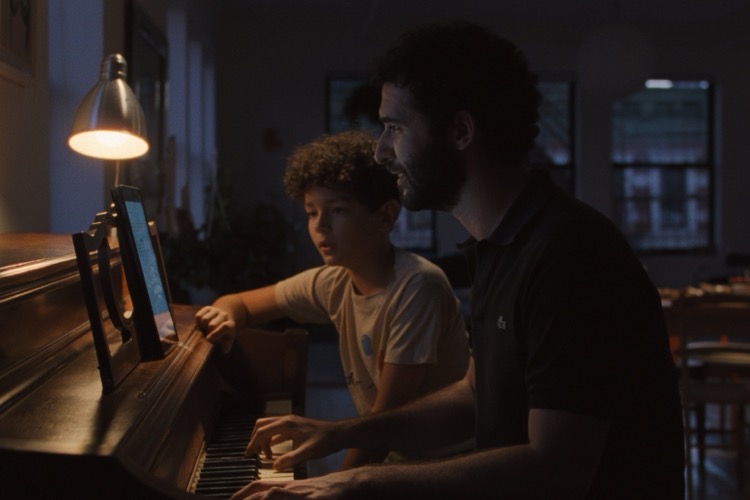
The following questions and answers are excerpted from a conversation that followed the NBR screening of Club Kid.
The film seamlessly blends chaos and humor with a very grounded emotional story. How did that evolve in the script?
Jordan Firstman: I come from a comedy writing background, so the first draft definitely leaned more comedic. There was just a moment in the process where I was like, “This is a drama.” Once I started thinking about it as a drama, all the comedy flowed in a more effortless way, and I cut, like, 80% of the jokes at a certain point. I realized there’s so much levity and heart and humor around the film that if I just lean into the emotions and the truth and the drama, I’m still gonna have so much love and light and laughter. Then it was really like a sculpture: you have this big block of marble, and you have all these ideas and all these storylines you wanna incorporate, and you just chip away until it’s something strong. I wanted to make something very honest to my community, very niche and specific. And I think in order to do that, I had to focus on a lot of universal themes, so I didn’t isolate anyone, and I could still get in my specificity, and people could still feel like they were invited to the party and in it with us.
I basically chose to do everything they tell you not to do on your first feature
You did a fantastic job casting. How did you find Reggie?
JF: Finding Reggie was obviously our first priority. We had our main casting director, Carmen Cuba, who did a brilliant job, and then we had Lucy Bevan in the UK, who had just cast Harry Potter, so she had just seen, like, 40,000 kids in the UK. Luckily Reggie didn’t get Harry Potter, ’cause then he couldn’t have done my movie. And we don’t need J.K. Rowling either… it’s actually the anti-J.K. Rowling movie. But I saw his face, and it was insane. It was the face that I had been writing, the face that was in my head the whole time, and I was just like, “Whoa.” Then I watched his tape, and he gave such a natural performance and wasn’t pushing at all.
Reggie, your performance feels very internal and natural, but Arlo really opens up as he gets more comfortable with New York and with Peter. How did you two develop that arc?
Reggie Absolom: We wanted to keep it as real as we possibly could, so for some scenes we’d do maybe one rehearsal. There’s one scene where I’m eating Cinnamon Toast Crunch when I call you Dad, and after every single cut, you’d be like, “Just make it way more chill. Just be way more chilled out, like it’s just your average morning.” I wasn’t used to that, really. But now I think I prefer to act that way, just really chilled and real.
JF: Reggie had done some series, some of them period, where you have to say the line exactly how it is. At the beginning I was encouraging improvisation, and I think your brain was not letting you go there, ’cause you thought it was against the rules. So it was about teaching him that the way I wanted to work was to break the rules. We also basically shot in order, so I think you see us get more comfortable with each other throughout the movie. When he arrives, he’s nervous, and we’re awkward with each other, and we had a little bit of that in the beginning. It wasn’t immediately besties like we are now. And as an actor, I hate rehearsals. Then I was like, “Okay, I’m a director, and now I have to do rehearsals.” So we did it once, and I was like, “I think we’re good, right?” I wanted to keep it really free and natural.
You were inspired by a lot of late-’70s cinema, and you shot your debut on 35 millimeter, on the streets of New York. Why make that choice, and what were the challenges?
JF: I basically chose to do everything they tell you not to do on your first feature: work with a kid, work with non-actors, shoot in real nightclubs, shoot in New York, shoot on film. There were definitely days where I’m like, “Why did I do all this stuff?” But I think all of the risks paid off. For me it was simple: every movie I’m referencing was shot on film. Of course, I got pushback, and I ended up giving my fees back to the movie to shoot on film. We made it back at Cannes! But it was worth it to me. An Unmarried Woman, the Paul Mazursky film, was a huge inspiration for the elegance I wanted. And the way we shot it grows with the character. We start in a very frenetic, scattered way, especially with that Uber and the party, and by the end it’s a lot of static shots; in the last couple of shots, the camera doesn’t move at all. My cinematographer, Adam Newport-Berra, is a total mastermind and genius, and I had so much trust in him. It’s funny when people ask me about the challenges, because either Adam hid them from me — or there were none! If you’re in the middle of a take and the film rolls out, you have to wait five minutes for it to reload, but whatever. The pros so outweigh the cons. It’s such a beautiful medium, and it feels so human. Developing film has to be done with human hands. And Peter loves records; he doesn’t like to talk on the phone. The whole movie has a bit of an analog feel to it, so it felt completely obvious that it had to be done that way.
Reggie, was there a particular scene that was more challenging for you as an actor?
RA: Definitely the one where I’m in the park and I’m getting really mad. I’d done short films where I had to get really sad and cry, but having to get really angry… the kid we used was actually really nice. I’d talked to him before, and he was really kind, so I was like, “I can’t do this.”
JF: He doesn’t like to curse. I would do this exercise with him and the kid where we would all just scream, “Fuck you, fuck you!” for, like, 30 seconds, and then I’d be like, “Action,” and run back to the monitor, and you guys would just go for it. At points, other kids in the park started screaming, “Fuck you, fuck you!” It was fun, but it really got you there. That was the first time I got really emotional on set, seeing you like that. After the fight, when your eyes are darting and you can’t even look at me… I hated seeing you like that. You were so committed.
RA: Before the scene, I didn’t wanna do it. But then I was like, “I need to make this as good as I can. I can’t make this movie worse because I don’t want to.”
JF: And yet many actors do! They’re like, “I am gonna make this movie worse ’cause I don’t wanna do this thing.”
RA: So I put in my AirPods and decided to get back to the old days of Slipknot, just to get myself in the brain. I thought of everything that has made me mad at someone before, and I tried my best to forget that the guy’s nice. And no, he wasn’t hurt. It was all safe.
JF: An eight-year-old stunt double is such a mindfuck. He’s like, “Hey, I’m the stunt double today.” I’m like, “You’re eight.”
RA: He asked for my number. He had, like, an iPhone 5 or something. I’m sorry, I just outed him.
JF: That’s the other thing about Reggie. I was planning to shoot the scene where I tell him he has to go one time. He cried on the first take, really emotional, and I was like, “We don’t have to do another one.” He’s like, “I got it, I got it.” You did, like, six takes and cried every time. We were gagged! I can do, like, two. And after, we were like, “Reggie, how did you do that?” And he goes, “I guess I’m just an emotional guy.”
RA: Did I say that? Oh my God. You would walk out of the room after the scene and close the door, and I’d be wiping my eyes. Then you’d open the door, and I’d be streaming with tears but really calm about it, and you were like, “Do you wanna do another one?” I was like, “Yeah, sure.” Tears everywhere.