
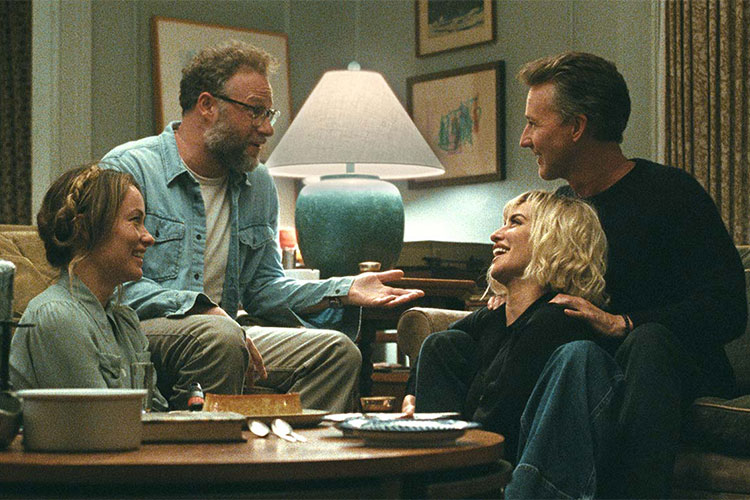
The following questions and answers are excerpted from a conversation that followed the NBR screening of The Invite.
It’s so unusual these days to have a comedy made by adults, for adults, in theaters! Tell us about when you first encountered the script, and how the movie evolved.
Olivia Wilde: It’s Sentimental in Spain, released here as The People Upstairs, and it’s based on a play written and directed by the same person. Cesc Gay made the play and made the film, and it’s one Edward and I had both seen and really liked. I then found out it had been reinterpreted in several different countries, including Korea, Italy, France, and Poland, and probably more. And I thought, “what is so true about this story that it could be interpreted in so many different languages?” I think that truth is that relationships are really difficult in every language. But it was very exciting to then read Rashida and Will’s adaptation. They were hired to write the English version, and that felt like an unbelievably exciting jumping-off point to create our own. And Edward had loved the original film, and knew about it way before I did.
Edward Norton: The premise is the same, the armature is the same, but what you just saw is very different in many dimensions. I’ve never worked on a film that was as improvisational. We were asked, in essence, to write our own characters, create the specifics of them, their backstories, and bring it all into this kind of whiteboard session. It was almost like a closed-circle intimacy share. Olivia even suggested that we each hold on to details about our characters that we didn’t share with the rest of us, and bring them into the scenes. So there’s a lot that goes on in the film that is highly improvisatory. You can see us being surprised by each other in some really substantial ways. It was far and away the most trust invested in a cast by a director that I’ve ever been a part of.
If we were making a movie about space, we’d probably call an astrophysicist
The film is beautifully controlled and composed, not what you’d expect from something with so much improvisation. How did you hold both at once?
OW: Even some of our references for the film are more vérité. You think of Husbands and Wives, obviously. What I love about that film is that you hear jokes barely on camera; sometimes the funniest punchline is off camera. It’s almost better to feel like you weren’t served it on a platter. You noticed it, and that’s thrilling. I wanted some of those elements, but with a very intentional style, a controlled chaos. That was a joy to create with our production designer, Jade Healy, who built that set on stage. She designed it over one weekend, because we were moving at such a clip, and she understood the assignment. Everyone did. The crew would stand around watching rehearsals for each scene, so engaged it was like they were watching little plays, because they didn’t know what was going to happen. Our sound mixer, Steve Morrow, was the same. I said, “I want everyone to be able to speak freely. I never want anyone to hold a line.” And so he’s live-mixing that dialogue and creating such clean tracks that in the edit I had no problem making it clear.
No one tells Seth Rogen how to lounge with his pants around his ankles.
OW: He just does it. I dare you to try!
Esther Perel was involved as a consultant. Without the truth of what Penélope’s character says toward the end, the film doesn’t quite work. Can you talk about that?
OW: If you’re going to be lobbing out these ideas about relationships, they should be based in research and fact. If we were making a movie about space, we’d probably call an astrophysicist.
EN: We are patients, not therapists.
OW: We are patients and never therapists, although now I consider myself a Perel disciple, the way I’ve been doling out advice. When I first read Will and Rashida’s adaptation, I saw the seeds of a Perelian philosophy in there, and I asked, “have you spoken to Esther?” They hadn’t yet, so I said, “let’s bring her in.” So many of the big shifts we made came from wanting to hone in on some of her ideas that have resonated with me for a long time. Things like, “you can have more than one relationship with the same person,” “taking responsibility for your own happiness,” “sex is not a thing you do, it’s a place you go,” compersion. These are all straight from her mouth, and I wanted her to help us stay honest and authentic. I also loved that Penélope bonded with her immediately and based Piña on Esther in many ways, including her hair.
EN: I don’t think she picked the wig until a week before shooting.
OW: Imagine being a director and hearing a week before shooting that your lead actress is going to use a wig, and how terrifying that was for a moment, until I saw it. I was like, but you’re Penélope, you don’t need a wig, you’re perfect.
EN: I remember you literally saying something on set. You were like, “It’s Penélope Cruz, she can’t look any more beautiful.” And then she put the wig on, and you were like, “Oh, yes she does.” Somehow she made it more beautiful.
OW: She put on the wig and it was like she transformed. She suddenly just became her.
In the beginning, the film is dialogue, but the images are very blurry and uncertain. By the end it’s clear and defined. Can you talk about that choice?
OW: In the beginning of the film, we’re in Joe’s mind, where he’s grasping at these memories of happiness that he can’t quite hold anymore. He knows he has this connection to a time when he felt happy, that there must be an origin to when they found each other and were in love. But they’ve reached a point in the relationship where it feels like a distant echo. And at the end, they’re once again playing that song, twenty years later, but now there is clarity. The clarity may not mean that they’re meant to be together forever, but it’s this understanding of their love for one another, and that it’s real. It’s not the same love they had in their twenties, the initial first blast of attraction. It’s something that’s actually really valuable, textured with all of this experience. I really loved that the Thelonious Monk song “I’m Confessing That I Love You” is what they’re playing at the beginning and the end. I loved that as a bookend, not because the idea is to return to who you were when you first met this person, but as an acknowledgment of its significance. And the score is such a character in this film. Our composer, Dev Hynes, created this Greek chorus of very dramatic, aggressive cello. It’s all one cello, even the percussion is on the cello. It’s discordant, and it represents their nerves. And yet the piano is this softer sound, another character that starts nostalgic and ends feeling very present and clear. There was also the fun of the windows. We start with this framing device in the credits of these compressing windows, and then we play with windows the whole movie — the Rear Window nod to voyeurism and being seen. And then we leave them at the end as neighbors, watching them in the same window.